
What is Data Engineering?
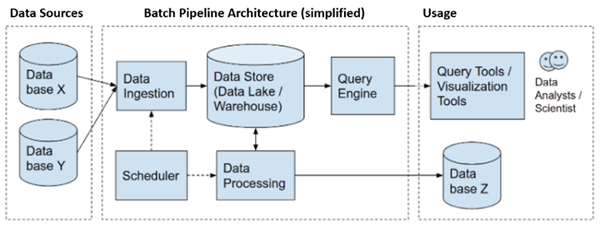
Engineers design and build solutions. Data engineers design and build solutions for data pipelines that transform and transport data into required formats to Data Scientists, Business Analysts, other End Users or to Stakeholders. Before the data can be consumed, it must be shaped into a highly usable state.
These pipelines fetch data from different sources and collect them into a single warehouse that represents the data uniformly as a single source of truth. The data sources can be of different varieties – SQL, NoSQL, Structured, Unstructured, RDBMS, File systems, etc.
How is it done?
Different skills, strategies and tools are used to build, maintain, and scale up the Data pipelines and Data warehouses. These are some of them –
SQL – This is the staple for Data Engineering tasks and expected to remain so for long time.
Data Modelling – This is one of the tasks that is done during the designing phase. It forms the foundation of the Data warehouse and involves knowledge in how to structure tables, where to normalize, denormalize. Having domain expertise is also important as a Data Modeller should know what business attributes are to be used as Grain, Dimensions and Facts.
ETL and ELT – These are two important strategies to design Data pipelines. ETL (Extract Transform and Load) and ELT (Extract Load and Transform) are different approaches used in different situations. Both these have their own suitable use cases. ETL is good for multiple sources Based on scenarios, we can have some more strategies also like ETLT approach.
Data Integration Tools – Also known as ETL tools. These are tools following low code/ no code approach. These are used in creating the Data pipelines. A project is divided into many jobs and each job has many components. The programming is done using GUI with the help of components. The tools provide components with functionalities to perform operations in simpler ways that otherwise would have been complicated/lengthier using programming languages. Each job has a clearly defined purpose.
These tools provide many “Data-centric” and “Pipeline-centric” features. Informatica, Talend, ODI (Oracle product), SSIS (Microsoft product) are some leaders in ETL tools arena.
Data Quality and Validation – ETL testing along with Database testing is another important skill under the Data Engineering umbrella. It ensures the quality of the primary thing – the data. The raw data from the sources pass through many stages and transformations before it is presented to the relevant data consumers. So, the ETL testing is done to make sure the data thus transformed is accurate. Depending upon the complexity of the project, ETL Testing cane be performed in various stages of the pipeline. There are some products also for automating the ETL Testing.
Afterall, Why is it done?
Data Engineering is not a part of the applications that perform or help in performing the Operations of an organization. Then why do we need Data Engineering? Data Engineering done on Operations data can give deep insights to major and minor parameters of an organization and their customers. In other words, today’s Business Intelligence has its foundation in Data Engineering. Data Engineering gives the picture of current health of an organization. It can also forecast the health of organization. This helps the managements to take better and informed decisions “based on Data” for better results in every possible area. Apart from determining an organization’s health, Data Engineers provide data to Data Scientists for further analysis to find solutions to problems for growth in existing area and new areas.
Sachin Bhatia
Tech Lead